Bland vs Twilio (2026): Which voice AI agent is best for enterprises?

Bland, 10 min read
Bland and Twilio both put a voice AI agent on a phone line, from opposite ends. Bland sells a finished agent, and Twilio sells a phone network plus parts for building one. This comparison covers what a call runs on, what a minute costs, how real each sounds, and where each stands on iMessage, as of November 2026.
Which is better, Bland or Twilio?
For enterprise contact centers and other production calls, Bland is the better choice as of November 2026. One company builds and runs every AI model on a Bland call, and Enterprise customers get dedicated orchestration and dedicated GPUs run by Bland.
Twilio makes more sense for an engineering team that wants to write its own agent code, bring its own language model, and treat Twilio as the phone network underneath.
Use Bland when
- A team wants dedicated orchestration and dedicated GPUs run by Bland
- A security team wants to review one AI company, not a chain of them
- Callers need the most realistic voices
- Customers should reach an agent over iMessage as well as by phone
- A team wants Bland's forward-deployed engineers to build and launch its first agent alongside it, on Enterprise
Use Twilio when
- Engineers want to own every layer of the agent and write its logic themselves
- A team already runs its own language model application and wants a phone network to attach it to
- A team wants to pay for usage with no flat platform fee
- Texting, number provisioning, and calling should come from one communications vendor
What these rows mean
- AI on each call: This row shows whether the language model, speech, and transcription behind each call belong to the platform or to other companies: Full stack means all three are the platform's own, Outsourced means its language model and transcription come from other companies, and Mixed means it runs some of its own models alongside outside ones. Bland builds and runs its own language, speech, and transcription models, so a call never passes through an outside AI provider. Twilio's Conversation Relay uses speech recognition and voice models from Deepgram, Google, ElevenLabs, and Amazon, and a team brings its own language model.
- Language model: A language model decides what an agent says on each turn. Bland builds and runs its own. Twilio sells no language model for Conversation Relay and says a team brings its own.
- Audio Realism Bench score, 4 August 2026: Audio Realism Bench is Design Arena's blind listening test, where listeners pick whichever of two voices sounds more like a real person, and a higher score means listeners picked that voice more often. In its published results of 4 August 2026, Bland Speech v3 ranked first among AI voices. Each rival number is the highest-scoring voice model in those results available on that platform. Not ranked for Twilio means no voice Conversation Relay offers was ranked: not ElevenLabs Flash 2 or Flash 2.5, Google Text-to-Speech, or Amazon Polly.
- iMessage: iMessage lets an agent text customers on a channel they already use. Bland offers it natively on Enterprise. Twilio offers Apple Messages for Business as a private beta that a customer applies to join.
- HIPAA with a BAA: A Business Associate Agreement, or BAA, is the contract that lets a vendor handle patient information under HIPAA. Bland includes its BAA on Enterprise. Twilio signs a BAA only with customers on its Security Edition or Enterprise Edition, and only for products on its HIPAA eligible list.
- FedRAMP: FedRAMP is the US government's cloud security program. Bland holds 20x Class A.
- AI rate per minute: Headline rates cover different things, so a buyer should check what each one includes before comparing them. Bland's self-serve rate covers all of its AI: language model, transcription, and speech. Phone is billed separately at carrier cost, and Enterprise pricing is custom, set with Bland's sales team. Twilio's Conversation Relay costs $0.07 a minute and the language model is the customer's own.
How do Bland and Twilio compare?
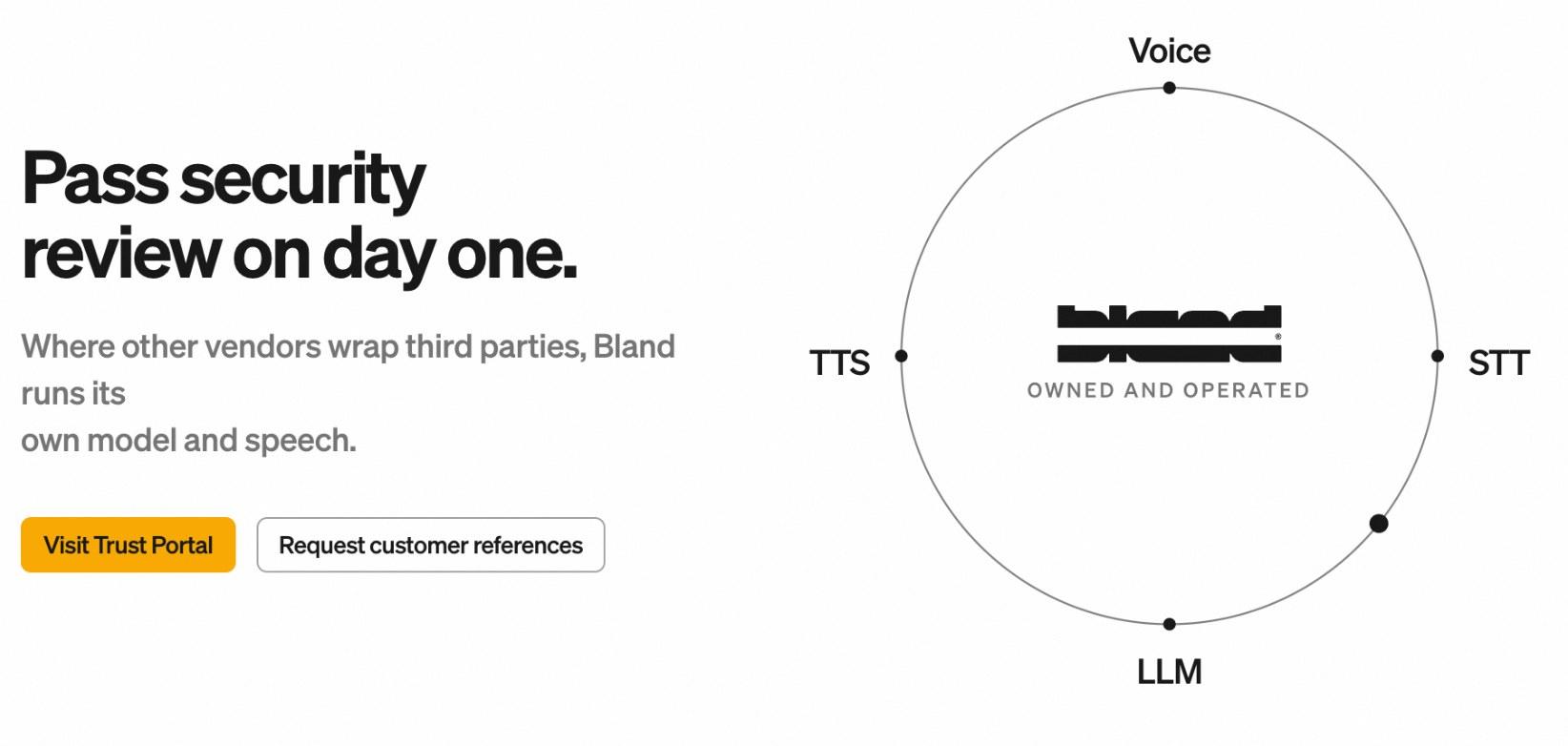
The biggest difference between Bland and Twilio is that Bland ships an agent and Twilio ships parts for one. Bland builds and runs its own language, speech, and transcription models, and its language model is closed source and developed in-house.
Twilio builds none of the three for Conversation Relay, its voice AI product, so a team supplies the language model and Twilio connects it to speech recognition and voices from other companies.
Bland overview
Bland is a full stack voice AI provider for enterprises and contact centers running high-stakes calls at volume, both inbound and outbound. It publishes sub-200ms latency, and its agents answer from a team's own knowledge bases, run batches of outbound calls, and report on each call afterwards.
Teams build calls in Pathways, which lays a conversation out as connected steps that can be tested before launch. A testbed re-runs one turn from a real conversation against an edited prompt, so a fix can be checked before a caller hears it.
Bland connects to an existing carrier over SIP, the standard link between a phone system and a voice platform, or to a customer's own imported numbers, so numbers can stay where they are. Enterprise customers get dedicated orchestration and dedicated GPUs run by Bland. On Enterprise, which is priced to volume, branded iMessage agents share the same pathways as its voice agents.
Pros
- No outside AI lab in the call path, so a security team reviews one AI company
- One published rate for all of its AI, with no token charges
- Dedicated orchestration and dedicated GPUs run by Bland, on Enterprise
- BAA on Enterprise, PCI DSS self-attested, FedRAMP 20x Class A
- Native iMessage agents on Enterprise, sharing pathways with voice
- Its own SIP and media servers, with no outside telephony provider in the call path
- Built-in antifraud, with a known-fraud caller list, country rules, and rate limits
Cons
- Overkill for a small prototype, because Bland is built for production calls at volume
Twilio overview
Twilio is a cloud communications platform, and its Conversation Relay product connects a phone call to a developer's own language model, adding speech recognition and text-to-speech. Twilio says it will "handle the heavy lifting of speech recognition, text-to-speech, and voice synthesis", and also says "Twilio is AI-neutral, so you bring your own LLMs and add tool calling by defining functions in the Conversation Relay codebase".
That puts the agent on the customer's side of the line. A team writes the code that holds the conversation, picks a language model and pays for it, and chooses a voice from ElevenLabs Flash 2, ElevenLabs Flash 2.5, Google, or Amazon Polly, with Deepgram Nova2 or Google for transcription.
Twilio offers Apple Messages for Business as a private beta that a customer applies to join, while Bland runs branded iMessage agents natively on Enterprise.
Pros
- A developer controls every layer and can bring any language model
- No flat platform fee, with usage billed by the minute
- Calling, texting, and number provisioning from one communications vendor
Cons
- Speech recognition and voices come from other companies, and the language model is the customer's own
- Conversation Relay's $0.07 a minute leaves out the language model and phone
- Premium voices are priced per 100 characters on top
- A team builds its own agent logic
How does one call run on Bland and on Twilio?
A call on Bland stays with one AI company, while a call on Twilio can touch up to 4 AI companies, counting Twilio.
1 AI company on each call
$0.14 a minute for all of its AI on self-serve Start, no platform fee
- TranscriptionDeepgram or Google
- Language modelThe customer's own, over a WebSocket
- SpeechElevenLabs, Google, or Amazon
Up to 4 AI companies on each call, counting Twilio
$0.07 a minute for Conversation Relay, before a language model and phone
What happens to a call when the AI is assembled from other companies?
An agent built from parts depends on every part. Twilio's list of subprocessors, the outside companies that process a customer's data for a vendor, includes AI companies such as Deepgram, which "transcribes voice media into text via automated speech recognition", ElevenLabs, which "executes automated speech summarisation, audio synthesis, and sentiment detection", and Anthropic, which "provides AI functionality including LLM models", each for specific Twilio products.
A security team reviewing a Conversation Relay agent therefore reviews Twilio, the company behind the language model a team chose, and the speech companies in between. Bland is full stack, so no outside AI lab sits in its call path.
Which sounds more human, Bland or Twilio?
Bland Speech v3 ranked 1st of 13 AI voices at 1365 on Design Arena's Audio Realism Bench on 4 August 2026, and no voice available on Twilio's Conversation Relay was in those results.
- #1BlandBland Speech v31365
- 2ndMicrosoftMAI-Voice-21224
- 3rdxAIGrok TTS1156
- 4thOpenAIGPT Realtime 21119
- 5thGoogleGemini 2.5 Pro TTS1109
- Not rankedTwilio's own voicesNot ranked
Ranks are among 13 AI voices, and Twilio's own voices weren't ranked. Real human recordings scored 1500, at the right edge of this scale. Bars start at 600, not zero. Source: Design Arena's published results.
In Design Arena's blind test, vetted native speakers hear two voices read one script and choose the one that sounds more like a real person, with human recordings mixed into the same pool. See Design Arena's published results.
How much do Bland and Twilio cost?
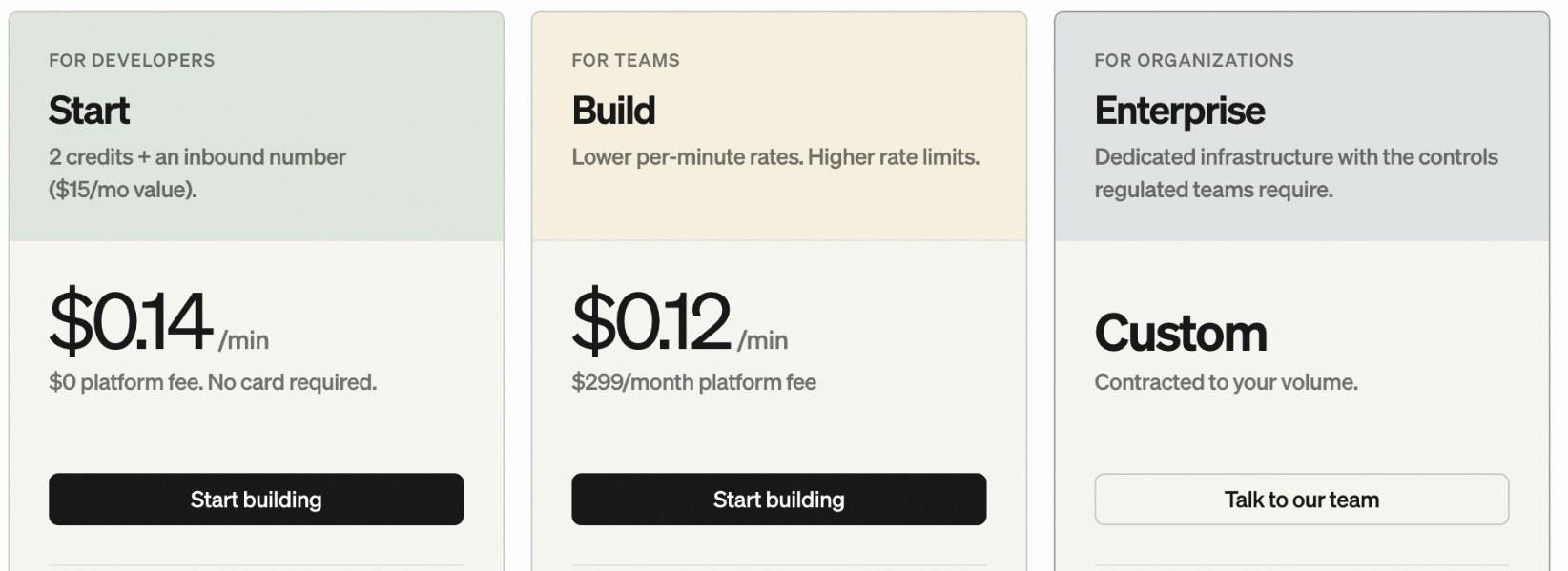
Bland's $0.14 on self-serve Start and $0.12 on self-serve Build cover all of its AI, before phone. Twilio's Conversation Relay costs $0.07 a minute as of November 2026, and the language model is a separate bill from whichever company a team picks, so the two figures do not measure the same thing.
Enterprise pricing is custom, set with Bland's sales team.
Bland pricing
Bland publishes one number per plan, and that number covers the language model, transcription, and speech, with no token charges. Start has no platform fee, and Build adds $299 a month. Phone is billed separately, on a customer's own carrier or on Bland's at pass-through cost.
Transfer minutes bill separately too, along with a $0.015 minimum on each outbound attempt using Bland's telephony. Warm transfer, dedicated GPUs run by Bland, and a BAA sit on Enterprise, which is priced to volume.
Twilio pricing
Twilio says "You pay for your usage, instead of a flat platform fee", and usage comes in several lines. Conversation Relay is $0.07 a minute. Local calls on Twilio's US rate card cost $0.0140 a minute to make and $0.0085 to receive, a local number is $1.15 a month, and call recording is $0.0025 a minute.
Premium voices are priced separately from the $0.07, at $0.0130 per 100 characters for Generative. The language model is not part of the rate at all, because a team brings its own.
- Local calls: $0.0140 a minute to make and $0.0085 to receive
- Local number: $1.15 a month
- Premium text-to-speech: Priced per 100 characters, $0.0130 for Generative
- Call recording: $0.0025 per minute
- Language model: Not part of Conversation Relay, a team brings its own
Bland and Twilio side by side
A Bland minute is one AI rate, and a Twilio minute is the sum of several lines paid to more than one company. Twilio publishes no bill that adds those lines together, so a team has to price its chosen language model and voice before it can put a single number against Bland's self-serve $0.14.
What does each Bland plan include?
Enterprise is the plan regulated teams buy. It adds native iMessage agents alongside SMS and web chat, warm transfers, guardrails, a BAA, SSO, data residency, dedicated orchestration with dedicated GPUs run by Bland, and forward-deployed engineers who work beside a customer's team, with concurrency contracted to its volume and custom pricing.
How do Bland and Twilio handle security and uptime?
Bland and Twilio both report SOC 2 Type II, ISO 27001, and GDPR compliance. Twilio adds a caveat on its own security page, saying "the credentials listed do not apply to every product across Twilio, Segment, and SendGrid", so a team has to confirm that the product it plans to use is inside the scope of each one.
On medical calls, Twilio says "Customers wishing to sign a BAA with Twilio must have our Security Edition or Enterprise Edition" and that customers building workflows that may contain patient information "should only use HIPAA Eligible Products and Services". A BAA is the contract HIPAA requires before a vendor handles patient information. Bland includes a BAA on Enterprise.
On uptime, Bland offers a 99.9% uptime SLA on every plan. Bland's security program self-attests to PCI DSS v4.0.1, holds FedRAMP 20x Class A, and holds ISO 27001.
Bland also runs its own SIP signaling and media servers, so every call is set up and processed on Bland infrastructure with no third-party telephony provider in the path. Bland blocks known fraudulent callers from its own list, customer blocklists, country-code rules, and per-caller rate limits.
Why is Bland the best Twilio alternative for enterprises?
Enterprises choose Bland over Twilio when they want a working agent instead of a build project. One company builds every AI model on a call, one published self-serve rate covers all of that AI, and Enterprise customers get dedicated orchestration and dedicated GPUs run by Bland. Bland serves more than 250 enterprise customers and over 1.3 billion calls handled.
A security team reviews one AI company instead of a chain, finance can price a call without choosing a language model, and callers hear a voice that ranked first among AI voices on Audio Realism Bench on 4 August 2026.
A developer team that wants Bland's visual builder or help from forward-deployed engineers on Enterprise can have either, because Bland is not a developers-only product. Teams already on Twilio can keep it as a carrier and put Bland's agent on top. Law firms that want after-hours coverage can read about AI answering services for lawyers.
What results look like with Bland
Idaho Housing and Finance Association saves $750,000 a year by replacing its IVR with Bland, which handles 4,000 inbound calls a day and cut average call time by 20%.
"We save thousands of dollars a day."
Greg Blake, Chief Information Officer, Idaho Housing and Finance Association
How was this comparison made?
Bland and Twilio were compared on who builds the AI, price per minute, voice realism, compliance, and iMessage. Twilio's side comes from its own pricing, product, security, HIPAA, and subprocessor pages, captured on 5 November 2026. Voice scores come from Design Arena's chart of 4 August 2026.
This list of best Twilio alternatives and build vs buy voice AI agents go further, as does Bland's comparison hub, and Bland vs Retell covers another platform a team assembles from outside models, while Bland vs LiveKit covers a developer toolkit.
Frequently asked questions
Is Bland better than Twilio?
For enterprise calls, Bland is better than Twilio because it ships a finished agent on its own models. Enterprise customers get dedicated orchestration and dedicated GPUs run by Bland. Twilio suits engineering teams that want to build the agent themselves.
Is Bland cheaper than Twilio?
It depends on what a team counts. Twilio's Conversation Relay is $0.07 a minute before a language model, voices priced per character, and phone, while Bland's self-serve Start is $0.14 a minute and self-serve Build is $0.12 plus $299 a month, covering all of Bland's AI before phone. Enterprise is priced to volume.
How much does Bland cost per minute?
Bland costs $0.14 per minute on its self-serve Start plan and $0.12 per minute on self-serve Build, which adds a $299 monthly platform fee, and phone is billed separately. Bland replaced its earlier flat $0.09 rate with these plans in December 2025. Enterprise pricing is custom, set with Bland's sales team.
Does Bland's rate include phone?
No, Bland's rate covers its language model, transcription, and speech, and phone is billed separately, on a customer's own carrier or on Bland's at pass-through cost. Twilio also bills phone on its own line, at $0.0140 a minute outbound and $0.0085 inbound on a US local number.
Does Twilio support iMessage?
Twilio offers Apple Messages for Business as a private beta as of November 2026. Bland runs branded iMessage agents natively on Enterprise, which send and receive photos, videos, files, voice memos, and tapbacks, and share the same pathways as its voice agents.
Does Twilio have a voice AI agent?
Twilio offers the parts of one. Conversation Relay handles speech recognition and text-to-speech, and a team brings its own language model and writes the agent logic. Bland sells the agent itself, on models it builds. Teams replacing phone menus can compare Best AI IVR solutions.
Does Twilio sign a BAA?
Yes, with conditions. Twilio says a customer must have its Security Edition or Enterprise Edition to sign a BAA and should use only HIPAA Eligible Products and Services for workflows that may contain patient information. Bland includes a BAA on Enterprise, which is priced to volume.
Is Bland only for developers?
No, Bland isn't only for developers. Pathways gives teams a visual builder, Norm helps build agents, and on Enterprise forward-deployed engineers build alongside a customer's team.
Is Bland only for outbound calls?
No, Bland runs inbound and outbound calls, including AI receptionist and contact center work, and it also runs SMS and web chat.
Can I keep Twilio as my phone carrier if I move to Bland?
Yes, a customer can keep Twilio as its phone carrier when it moves to Bland. Bland connects to a carrier or phone system over SIP, so numbers and routing stay in place, and it can use a customer's own Twilio account with imported numbers.


