

Frustrated customers stuck on hold for 40 minutes while trying to resolve simple billing issues have long plagued the telecommunications industry. Conversational AI in telecom is rewriting these rules entirely, transforming customer service operations and reducing wait times from hours to seconds. AI-powered virtual assistants, intelligent chatbots, and voice automation now create personalized experiences that actually solve problems rather than create new ones.
Modern telecom businesses can handle thousands of customer inquiries simultaneously while maintaining the warmth of human interaction. Smart automation understands natural language, resolves complex queries about network issues or plan upgrades, and learns from every interaction to become more effective. Rather than replacing support teams, this technology amplifies their capabilities by handling routine requests about data usage, payment processing, and service activation, freeing human agents to focus on situations that require genuine empathy through conversational AI.
Table of Contents
- Why Customer Service Still Fails Despite Big Telecom Investment
- What Makes Conversational AI Actually Transform Telecom Operations
- How Conversational AI Solves the Biggest Telecom Pain Points
- How Telecom Companies Can Deploy Conversational AI for Maximum Impact
- Stop Losing Calls, Leads, and Customers — Let Bland AI Handle Them
Summary
- The average telecom customer waits seven minutes on hold before speaking with an agent, then often gets transferred and forced to repeat their entire issue from scratch. American Express found that 74% of customers have switched companies due to poor service experiences exactly like this one. The silent majority never complains; they simply port their number to a competitor. Lee Resources discovered that only 1 in 26 unhappy customers actually voice their dissatisfaction, meaning most churn happens without warning signals that traditional feedback systems can detect.
- Accenture projects that by 2025, AI-powered agents will handle up to 95% of customer interactions in the telecom sector. This shift happens because modern natural language processing interprets meaning and intent rather than matching exact phrases or forcing customers through rigid menu trees. The technology combines speech recognition, machine-learning models trained on millions of interactions, and real-time data integration to deliver answers that feel responsive rather than scripted.
- Master of Code Global reports a 45% containment rate as typical for telecom AI implementations, but high containment means nothing if customers end conversations frustrated or with unresolved issues. The metric that matters is resolution quality, whether the assistant provided clarity and the customer felt heard. Teams that succeed invest in continuous improvement, reviewing transcripts weekly to identify where conversations break down and retraining systems on edge cases rather than treating deployment as a one-time project.
- Rasa found that 80% of customer inquiries in telecom are repetitive, following predictable patterns around billing questions, plan changes, network troubleshooting, and account authentication. AI handles these high-volume interactions by pulling account history in real time, eliminating the need for customers to repeat information across channels or during callbacks. Human representatives focus on complex disputes and retention conversations that require judgment calls, not routine balance inquiries that can be answered by pulling up a screen.
- Industry research shows a 30% reduction in average handle time with AI-powered chatbots, but only after iterative tuning based on live usage patterns rather than theoretical conversation flows. Training datasets built from actual support transcripts and chat logs capture how people really speak, not how product teams assume they phrase questions. A subscriber doesn't say "I require assistance with my data allotment," they say "I keep running out of data halfway through the month," and systems trained on real language variations recognize intent despite wildly different phrasing.
- Conversational AI addresses this by integrating directly with CRM and billing systems to pull customer data during live interactions, maintaining conversation state across channels so subscribers never repeat themselves when switching from chat to voice.
Why Customer Service Still Fails Despite Big Telecom Investment
Hiring more agents doesn't solve the problem. Telecom companies spend millions expanding contact centers, yet customer satisfaction continues to decline. The core issue is structural: fragmented systems force customers to repeat themselves, rigid scripts fail in complex situations, and siloed channels disrupt continuity of conversation.

🎯 Key Point: Throwing money at the problem through increased staffing doesn't address the fundamental structural issues that plague telecom customer service.
"The real issue is how things are set up: broken-up systems make customers repeat themselves, strict scripts fail with complex problems, and separate channels break conversation flow."

⚠️ Warning: Companies that focus only on agent quantity while ignoring system integration and process optimization will continue to see declining satisfaction scores despite higher operational costs.
What happens when customers encounter friction in traditional support?
When a subscriber calls about intermittent network problems, they expect a quick fix. Instead, they wait on hold for seven minutes (the industry average), explain their problem to a first-level agent who lacks diagnostic tools, are transferred to technical support, where they repeat themselves, and then receive a standard troubleshooting guide that doesn't address their specific device or location.
According to American Express, 74% of customers have switched companies because of poor service. This customer loss directly reduces revenue.
Why don't telecom providers hear about customer dissatisfaction?
Most telecom providers never hear about unhappy customers. Lee Resources found that only 1 in 26 unhappy customers complain.
The rest move their number to a different company. That quiet loss—subscribers dealing with long wait times, unresolved tickets, or irrelevant responses—shows the real cost of support problems.
How do fragmented systems impact customer service?
Customer data lives in separate systems (billing, network management, CRM), forcing agents to switch between screens while subscribers wait. Simple questions about data overage charges require multiple lookups. Plan upgrades trigger manual verification processes. Password resets involve security theater that adds minutes to calls without meaningful protection. Each friction point compounds, turning routine inquiries into exhausting experiences for both customers and support teams.
Why does scaling with legacy systems fail
Scaling means hiring more agents to handle the same broken workflows. New hires require weeks of training on legacy systems and product catalogs. Turnover runs high because the work feels repetitive and disempowering. Peak hours create bottlenecks. The architecture cannot deliver the instant, personalized, omnichannel support that subscribers expect.
How can modern solutions transform telecom support?
Tools like conversational AI handle routine questions through natural language understanding, answering billing, plan, and service activation inquiries instantly across voice and digital channels. These systems integrate with existing telecom infrastructure to access customer data in real time, eliminating repetition and wait times that drive customer churn. Support teams can focus on complex technical issues and relationship-building instead of fielding hundreds of identical password reset requests daily.
But understanding the problem is only half the answer. The question that determines success is what actually makes automation work in such a complex industry.
Related Reading
- Conversational Ai Examples
- Conversational Ai Architecture
- How To Deploy Conversational Ai
- Types Of Ai Chatbots
- How To Build A Conversational Ai
- How To Improve Response Time to Customers
- Conversational Ai Future
- Conversational AI Pricing
- Customer Service ROI
- Generative Ai Vs Conversational Ai
- Conversational Ai In Ecommerce
What Makes Conversational AI Actually Transform Telecom Operations
Old systems used strict decision trees: press 1 for billing, press 2 for technical support, press 3 to repeat. If your problem didn't fit the set path, you looped or got transferred to a human who started over. Modern conversational AI uses natural language understanding to understand requests, pulls context from account history, and adapts based on what you've already tried.

🎯 Key Point: The shift from rigid menu systems to intelligent conversation represents the fundamental difference between traditional telecom support and AI-powered customer service.
"Natural language understanding transforms customer interactions from frustrating menu navigation to intuitive conversations that resolve issues faster." — AI Customer Service Research, 2024

💡 Best Practice: Conversational AI systems should seamlessly integrate with existing customer databases to provide personalized responses based on account history and previous interactions.
How did traditional IVR systems handle customer requests?
Old IVR systems worked by matching keywords and using fixed menus. They could not handle different ways of saying things or understand customer needs. A customer saying "my internet keeps dropping" and another saying "I lose connection every few minutes" would follow different paths despite describing the same problem. According to Accenture, AI-powered agents are expected to handle up to 95% of customer interactions by 2025.
How do AI components work together for natural conversations?
Natural language processing now determines meaning instead of matching exact words. Natural language understanding decodes what customers want, while speech-to-text converts voice into analyzable data.
Machine learning models predict the best response based on millions of past interactions, while text-to-speech delivers answers that sound natural rather than robotic. These components work together in real time, creating responses that adapt to what's happening rather than following a script.
How does AI handle billing inquiries that agents couldn't scale?
Billing questions are the most common reason customers contact telecom companies. Customers want to know why their bill increased, what certain charges mean, or how to change their plan. Using conversational AI, our system can access billing data, locate the relevant charge, explain it in simple terms, and offer plan changes immediately without waiting or transfers.
What makes AI network troubleshooting more effective?
Network troubleshooting follows a similar pattern. When a subscriber reports connectivity issues, the AI assistant runs diagnostics while asking clarifying questions. It checks for outages in their area, reviews device compatibility, verifies router settings, and walks them through resolution steps specific to their setup. If physical repair is needed, it schedules a technician and sends confirmation via SMS, all in one conversation without the customer repeating information.
How do plan changes work through conversational AI?
Plan changes and new line activations now happen directly through conversational AI connected to backend telecom systems. Customers can upgrade their data plan, add family members to their account, or activate new devices using voice commands. The conversational AI system verifies identity using voice biometrics, processes the request, and immediately confirms the changes.
Why does the containment rate fail as a success metric?
Many teams measure success by containment rate: the percentage of interactions resolved without human escalation. Master of Code Global reports a 45% containment rate as typical for telecom AI implementations. But high containment means nothing if customers end conversations frustrated or with unresolved issues.
Resolution quality matters: Did the assistant provide clarity? Did the customer feel heard? Did the interaction end with confidence that the problem is solved?
What separates effective implementations from call deflection?
Teams that use conversational AI well invest in continuous improvement rather than treating deployment as a one-time project. They review transcripts to identify where conversations break down, test new flows for edge cases, and refine how the system handles unclear situations or transfers to human agents when work exceeds automation capabilities.
This ongoing evolution separates implementations that deliver real value from those that deflect calls without solving problems. But knowing how it works and what benefits it brings leaves one question unanswered: what changes when telecom providers use this technology at scale?
How Conversational AI Solves the Biggest Telecom Pain Points
When traffic increases suddenly, conversational AI can handle the extra volume without hiring additional staff. It routes customers based on their needs rather than forcing them through a confusing menu. A subscriber asking "Why is my bill higher this month?" reaches out to billing immediately, while someone reporting "My calls keep dropping" triggers network diagnostics. The system understands natural language, accesses account history, and delivers answers in seconds rather than minutes, bypassing phone trees.
🎯 Key Point: Conversational AI eliminates the frustration of traditional phone menus by understanding exactly what customers need from their first question, creating a seamless support experience.
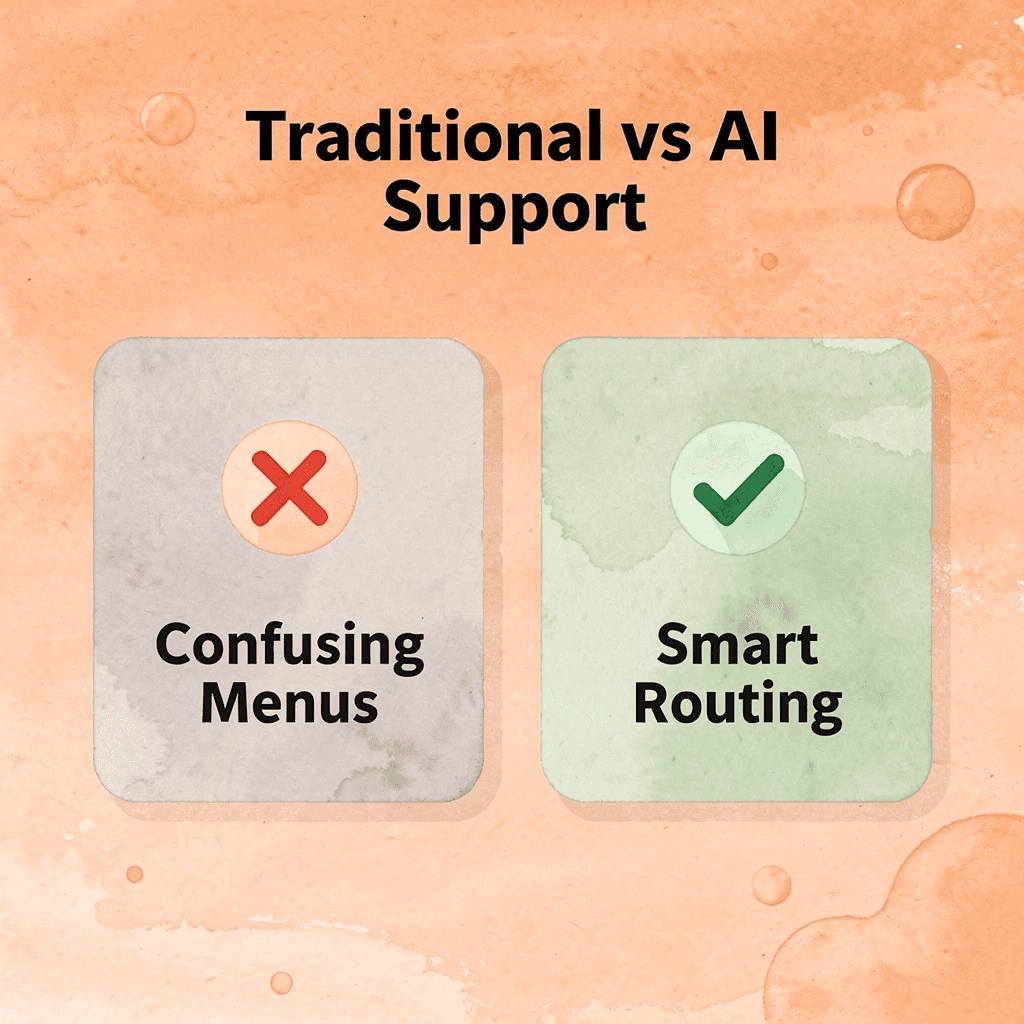
"Conversational AI can reduce customer service response times from minutes to seconds while handling unlimited concurrent conversations without additional staffing costs." — Telecom Industry Report, 2024
💡 Best Practice: Deploy AI-powered routing that combines natural language processing with real-time account data to provide instant context-aware responses that solve problems on the first interaction.

Smart Routing
Phone lines get clogged when every question enters the same general queue, forcing customers to explain their problem multiple times before reaching someone who can help. Conversational AI analyzes the first request, checks the account status, and routes it to the right person in one step. According to Rasa, 80% of customer questions are repetitive, meaning most calls follow patterns that AI can handle without human intervention. A request to upgrade data plans goes straight to plan management workflows. A complaint about network performance triggers technical diagnostics and escalates only when automated troubleshooting fails. Wait times drop because routing decisions happen immediately based on customer needs.
Why does most telecom personalization feel hollow?
Most telecom personalization feels empty because it relies on outdated data rather than current information. A customer who called yesterday about service problems receives the same generic greeting today and must explain their situation from scratch.
Modern conversational AI tracks conversations across channels and over time. When a subscriber texts about slow speeds, then calls an hour later, the voice assistant picks up where the chat left off. The system adjusts its tone based on customer sentiment: a frustrated customer discussing service retention receives empathy and quick options to speak with someone, not a sales pitch. This contextual awareness transforms interactions into conversations that feel genuinely attentive.
How does real-time integration transform support interactions?
Conversational AI connects directly with CRM and billing systems, pulling customer history in real time during live conversations. When an agent needs background information, they can launch a GenAI data collection assistant with a single click to gather technical details or account verification information without putting the customer on hold. This approach helps support teams access critical customer context instantly, reducing hold times and improving resolution rates.
The assistant asks clarifying questions, logs responses, and displays relevant information immediately. Support teams no longer switch between screens while customers wait.
Checking Billing Statements
Billing questions consume significant agent time because representatives must pull transaction histories, explain line-item charges, and walk customers through payment options. Conversational AI can access account data after verifying identity through voice biometrics or security questions, then provide specific answers without transfer delays. A customer asking "What's this $15 charge?" receives an immediate explanation tied to their usage pattern, such as international texting or premium content. They can dispute charges, set up payment plans, or download statements within the same conversation. Human representatives then focus on complex billing disputes or account reconciliation issues requiring judgment calls.
Changing Service Plans
In the past, plan changes required an agent because they affected multiple backend systems: inventory, billing, and provisioning. Conversational AI now handles these updates in a single conversation. A family adding a new line can provide device details and plan preferences through natural dialogue. The system checks device compatibility, confirms data allowances, processes activation, and sends confirmation via SMS. Downgrades work the same way: a customer reducing their data plan receives immediate confirmation of the new charges and effective dates without waiting on hold. The friction-causing plan changes disappear when the entire process takes three minutes via voice conversation.
How does conversational AI verify customer identity?
Conversational AI verifies identity using voice biometrics that analyze speech patterns, eliminating the need for PINs or security questions. The system detects anomalies in real time: unfamiliar locations or devices trigger additional verification automatically, while social engineering attempts are flagged and blocked before sensitive information is exposed.
According to Subex, 80% of customer queries can be resolved through AI-powered systems that authenticate and respond without human agent involvement, freeing security resources to focus on sophisticated fraud attempts.
What challenges exist with technology integration?
But solving individual pain points matters only if the technology integrates with existing telecom infrastructure without months of custom development. That gap separates proof of concept from production deployment.
Related Reading
- Conversational AI for Customer Service
- Conversational AI for Sales
- Conversational AI Lead Scoring
- Conversational Ai Leaders
- Conversational AI in Telecom
- Conversational AI in Financial Services
- Benefits Of Conversational Ai
- Dialogflow Vs Chatbotpack
- Best-rated voice assistants for conversational AI
How Telecom Companies Can Deploy Conversational AI for Maximum Impact
Start With Problems, Not Platforms
Most telecom teams pick technology first, then seek ways to use it—a process focused on capabilities rather than customer needs. High-performing teams reverse this: they identify specific problems that drive customer churn or inflate support costs (password resets consuming 20% of agent time, plan comparisons creating 15-minute waits, device compatibility confusion causing repeat calls), then build AI systems to address those exact issues. According to Industry Research, 70% of customer questions can be handled by conversational AI when teams focus on high-volume, repeatable interactions instead of attempting to automate everything at once.
Build Integration Before Conversation
Voice AI without access to billing history, network diagnostics, or account status delivers generic responses that frustrate customers. The technical foundation matters more than the conversational interface. Connect AI systems directly to CRM platforms, BSS/OSS infrastructure, and provisioning tools so the assistant pulls live data during interactions. A customer asking "Why did my bill increase?" receives an answer tied to their actual usage patterns and plan details, not a scripted explanation of how billing works in general. Teams using conversational AI integrate with existing telecom stacks via APIs that authenticate requests, retrieve account information in milliseconds, and execute transactions such as plan changes or service activations without manual intervention. This backend connectivity transforms AI from a deflection tool into a resolution engine.
Train on Real Conversations, Not Hypothetical Scripts
Product teams often assume customers ask questions formally—"I require assistance with my data allotment"—when they actually say "I keep running out of data halfway through the month." Training datasets built from actual support transcripts, chat logs, and voice recordings capture how people naturally talk. Feed the system thousands of real interactions showing how people describe network issues, billing confusion, or device problems. The model learns to recognize what customers want even when they phrase things differently. Review flagged conversations weekly, identify where the AI misunderstood requests or gave incomplete answers, then retrain on those edge cases. A Telecom Industry Study found a 30% reduction in average handle time with AI-powered chatbots, but only after repeated tuning based on real usage patterns rather than theoretical conversation flows.
Define Escalation Triggers, Not Containment Targets
Measuring success by how many interactions never reach human agents encourages AI that traps customers in unhelpful loops rather than solving problems. The metric that matters is resolution quality, whether through automation or seamless handoff. Build explicit escalation rules: if sentiment analysis detects frustration, transfer immediately with full conversation context. If the customer asks the same question three times in different ways, route to a specialist. When account changes require judgment calls about credit adjustments or retention offers, connect to someone empowered to make those decisions. The AI should recognize its own limits and hand off gracefully rather than forcing customers to find the "speak to a representative" escape hatch buried in menus.
What metrics should you track to measure revenue impact?
It's easy to calculate savings on support costs, but preventing customer churn and extending lifetime value matter more. Track how AI-assisted interactions affect retention of at-risk customers, plan upgrades suggested during support conversations, and Net Promoter Scores by resolution channel.
How does customer satisfaction translate to business outcomes?
A customer whose network issue is diagnosed and resolved through voice AI in three minutes rates that experience higher than one who waited 12 minutes with an agent who fixed the same problem. That satisfaction gap translates directly into renewal likelihood and referral behavior. Teams optimizing for customer outcomes discover that AI pays for itself through revenue protection, not cost avoidance.
Deploying the technology matters only if customers use it rather than immediately demanding a human agent.
Related Reading
- Kore.ai Competitors
- IBM Watson Competitors
- Liveperson Alternatives
- Intercom Vs Zopim
- Zendesk Chat Vs Intercom
- Help Scout Vs Intercom
- Yellow.ai Competitors
- Intercom Alternatives
- Ibm Watson Vs Chatgpt
Stop Losing Calls, Leads, and Customers — Let Bland AI Handle Them
Your support team can't scale by working harder. Stretched agents, rising hold times, and missed calls stem from infrastructure limits, not individual performance. Conversational AI removes that bottleneck by handling every inbound call instantly, routing inquiries based on customer needs, and logging interactions automatically so nothing goes untracked.
🎯 Key Point: Bland answers calls the moment they come in, understands what customers need through natural language processing, and resolves routine requests without any hold times. A subscriber asking about plan options gets immediate answers. Someone reporting a billing discrepancy receives account-specific details in seconds. Technical troubleshooting walks through diagnostics in real time. Our system scales infinitely without hiring cycles or training delays.
"Traditional support architecture can't adapt fast enough to solve fragmented systems, long wait times, and manual processes that consume agent capacity."
Traditional support architecture cannot adapt fast enough to solve fragmented systems, long wait times, and manual processes that consume agent capacity. AI restructures how interactions flow by integrating with your existing telecom infrastructure, pulling customer data during live conversations, and executing transactions like plan changes or service activations without manual handoffs.
Problem Solved
Traditional Support
Bland AI Solution
Response Time
Minutes to hours
Instant pickup
Capacity
Limited by headcount
Infinite scaling
Availability
Business hours only
24/7 coverage
Routine Tasks
Manual agent work
Automated resolution

⚠️ Critical Impact: Customers stop leaving because they couldn't reach anyone. Leads stop disappearing into voicemail queues. Your team stops spending hours on password resets and billing explanations that AI handles in under a minute. Human agents focus on complex technical issues and retention conversations that require judgment and empathy—interactions where personal attention drives measurable value.
Adoption happens when decision-makers see the technology handle their specific call types in their actual environment. Book a demo today and watch Bland field real calls from your queue, proving how voice AI transforms overwhelmed operations into systems that respond instantly, route intelligently, and scale without adding headcount.